


Get the edge over other buyers, and a $10,000 seller guarantee
I Want the Edge!For Realtors, tax season isn’t just about filing. It’s about understanding how fluctuating commission income, quarterly payments, and business deductions all work together.
This guide breaks down what’s new for the 2026 filing season, important deadlines, the latest tax brackets, and the most common deductions real estate professionals should be tracking.
For 2025 income (filed in 2026), here are the deadlines to know:
April 15, 2026 — Tax filing deadline
April 15, 2026 — Extension request deadline
October 15, 2026 — Extended filing deadline
Most Realtors are considered self-employed, which means taxes are not automatically withheld from commissions. If you expect to owe at least $1,000 in federal taxes for the year, the IRS generally requires quarterly estimated tax payments.
These payments are typically due in:
April
June
September
January (of the following year)
Missing estimated payments can result in penalties, even if you pay in full at filing time. Working with a tax professional can help you determine how much to set aside throughout the year.
Most agents will file Form 1040 along with Schedule C, which reports business income and expenses. Schedule SE is used to calculate self-employment tax. If you pay contractors such as photographers, transaction coordinators, or virtual assistants, you may also issue 1099 forms.
Keeping clean, detailed records of commissions, fees, marketing costs, mileage, and other business expenses throughout the year makes everything significantly easier when it’s time to file.
There are a few updates this season agents should have on their radar:
Standard deduction increased again
The standard deduction went up for 2025 returns, which may affect whether you itemize personal deductions. Keep in mind, this does not impact your business write-offs on Schedule C. Those still fully apply to your real estate income.
Mileage rate is now 70 cents per mile
For agents constantly driving to showings, listings, inspections, and closings, this is a big one. Accurate mileage tracking can make a meaningful difference.
Payment app reporting still matters
If you receive business payments through Venmo, PayPal, or other platforms, you may receive a 1099-K depending on thresholds. Even if you don’t receive a form, that income is still taxable and must be reported.
IRS Direct File is not operating this season
The IRS is not offering its Direct File program this year. IRS Free File is still available for qualifying taxpayers, which may be helpful for clients expecting refunds or looking to reduce filing costs.
Gift tax limits remain high
The annual gift exclusion stays at $19,000 per person. The federal estate and gift exemption also remains historically elevated. This is helpful for clients gifting down payments or transferring real estate, though future changes are still being discussed.
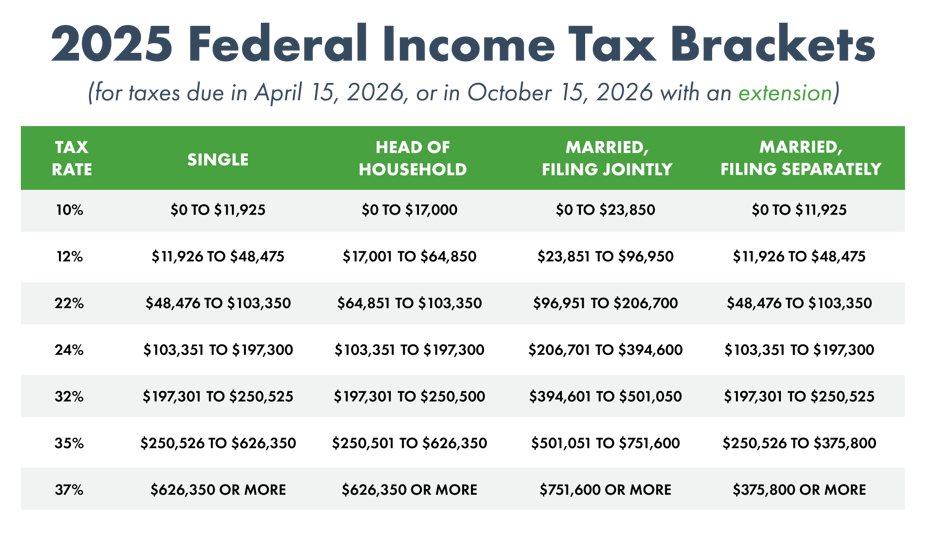
Federal income tax brackets are adjusted each year for inflation. For tax year 2025 (the return you file in 2026), several income thresholds increased slightly.
The highest federal tax rate of 37% now applies to single filers once taxable income exceeds $626,350.
For married couples filing jointly, that same 37% rate doesn’t apply until income exceeds $751,600.
Married filing separately hits the 37% rate at $375,800, essentially half the joint threshold.
This matters because tax brackets are progressive. Moving into a higher bracket does not mean all of your income is taxed at that rate — only the portion that falls within that bracket.
For married agents, filing status can make a meaningful difference in overall tax liability, especially in higher-income years when commissions spike. The chart below outlines all 2025 federal income tax brackets by filing status.
For tax year 2025 (filed in 2026), the standard deduction increased to:
$15,750 for single filers
$31,500 for married filing jointly
$23,625 for head of household
Many Realtors take the standard deduction personally while still deducting business expenses separately on Schedule C.
Some taxpayers choose to itemize instead of taking the standard deduction. Common itemized deductions include:
Mortgage interest
State and local taxes (subject to limits)
Charitable contributions
Medical expenses above IRS thresholds
Certain energy-efficient home improvement
Itemized deductions apply to personal taxes only.
Realtor business expenses are deducted separately on Schedule C before taxable income is calculated. Even if you work under a brokerage, you are typically considered self-employed for tax purposes.
Typical deductions include:
Always follow IRS guidelines when deducting business expenses, and work with a tax professional who understands real estate income. Tax laws shift, income varies, and every agent’s situation is different.
Churchill Mortgage does not provide tax advice, but we do provide ongoing support for our Realtor partners. Explore our Agent Resources site for tools, market updates, and co-branded materials designed to help you serve your clients well all year long.
The information contained herein is general in nature and based on authorities that are subject to change. Churchill Mortgage guarantees neither the accuracy nor completeness of any information and is not responsible for any errors or omissions, or for results obtained by others as a result of reliance upon such information. Churchill Mortgage assumes no obligation to inform the reader of any changes in tax laws or other factors that could affect information contained herein. This publication does not, and is not intended to, provide legal, tax or accounting advice, and readers should consult their tax advisors concerning the application of tax laws to their particular situations.
Check our FAQs for responses to our most popular Realtor questions about the 2026 tax season.

By submitting this form, I/we agree to your Privacy Policy Terms of Use and authorize Churchill Mortgage Corporation and/or their Preferred Provider for our area and/or The Churchill Agency to receive the above information to assist in obtaining a home loan.
I/we also authorize Churchill Mortgage Corporation, The Churchill Agency and/or their Preferred Provider for our area to contact us regarding but not limited to mortgage and insurance services and products via telephone, mobile phone (including through automated dialing), and/or email, even if telephone numbers or email I/we provide are on any Do Not Call/Contact Registry, such as corporate, state, or the National Do Not Call Registry.
The submission of this form does not constitute in any way a formal loan application or a commitment for a loan. By communicating with us by phone, you consent to calls being recorded and monitored. By participating, you consent to receive text messages sent by an automatic telephone dialing system. Consent to these terms is not a condition of purchase.
